Ask Me Anything with Atkins’ Dr. Jon - #2
Dr. Jon unpacks the latest research on nutrition’s role in weight management and all your GLP-1 questions.

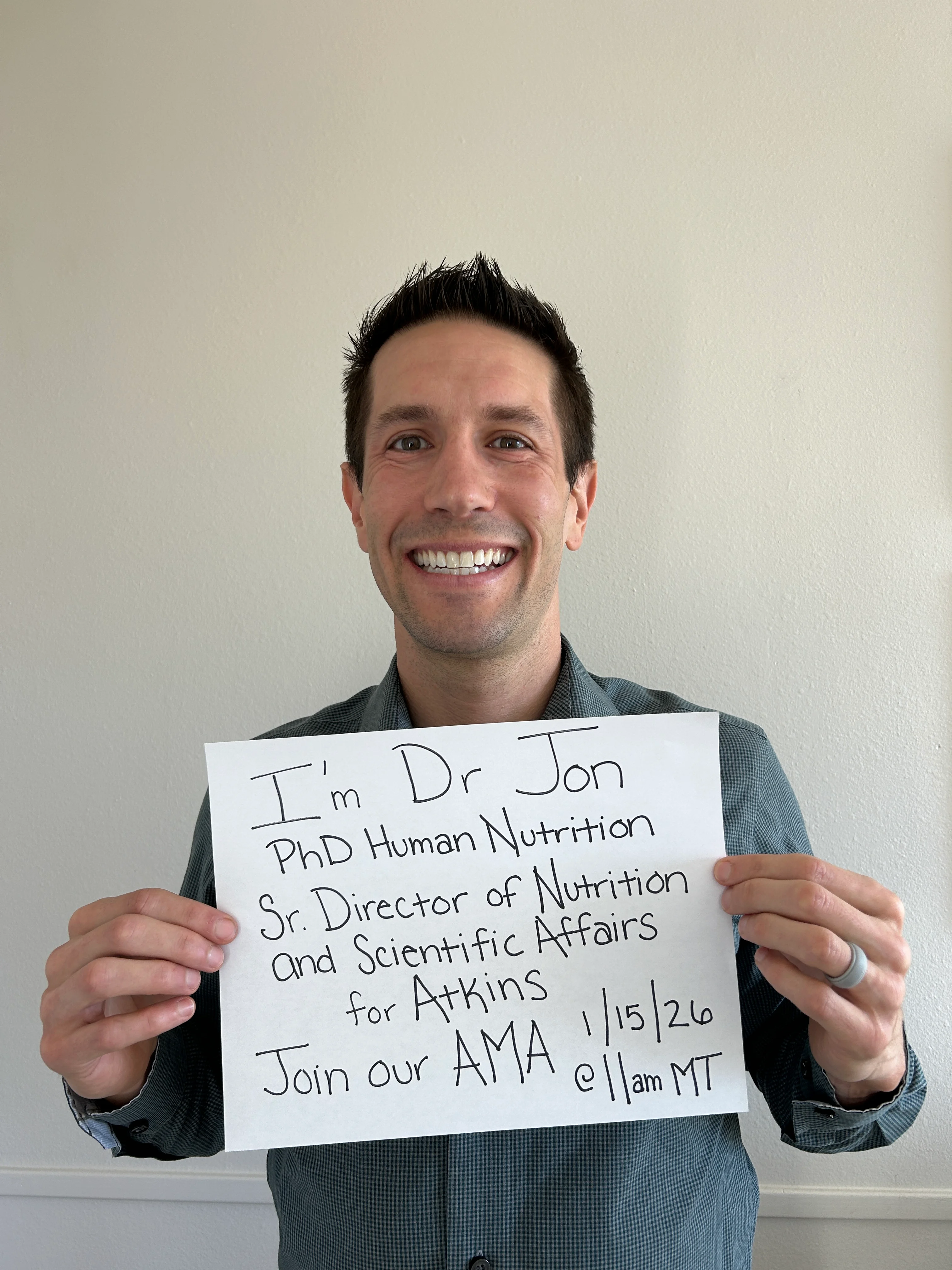
Dr. Jon, Ph.D. in Human Nutrition and Atkins’ Senior Director of Nutrition and Scientific Affairs, answered some of your biggest questions about nutrition and weight management (with or without prescribed weight loss medications), in Atkins latest Ask Me Anything (AMA) session on Reddit. Here are the highlights:
More Discussion About GLP-1s
Learn what to eat while on and off GLP-1s, how to preserve muscle while losing fat and the science behind the mechanisms of “food noise”.
Q: What are your top nutrition habits people should build while they’re on GLP 1s, so they have a better chance of maintaining weight loss after stopping?
What’s a question about Atkins, low carb, or GLP 1s you wish more people would ask you?Dr. Jon: Well, I think there is a still A LOT to learn about what nutrition needs to look like when on GLP-1s. BUT there was a really nice comparison done of weight regain in behavioral interventions vs. GLP-1 discontinuation, which pretty clearly showed that behavioral interventions generally have slower weight regain after they're "discontinued" compared to GLP-1s, so it’s a nice indication for how important making learning new habits can be for maintaining weight loss. It’s also been shown that some of the changes that GLP-1 users make do stick around after they discontinue the medication, so use your time on a GLP-1 to establish new, healthy habits. This is your time for a reset and taking a break from food noise so you can focus on making those better-for-you choices. At the end of the day, we don't really have any concrete research around what should be done to help. I can speculate that focusing on foods that really promote satiety like protein and fiber may help, if you're looking to prevent weight regain, I think the new inverse dietary guidelines pyramid could be a nice starting point.Q: If someone is using GLP 1s for weight loss, what does a “smart” meal plan look like to protect muscle and stay healthy?Dr. Jon: I think it’s setting a realistic and achievable protein target, probably 1.2-1.5 grams of protein per kilogram of target body weight. We've also seen in the literature that protein intake is really low earlier in the day for GLP-1 users, so prioritizing it early in the day would be part of that meal plan. It looks like GLP-1 users consume around 40% fewer calories, so they really need to prioritize super nutrient-dense foods if you want to get enough positive nutrition in.Q: Do people who lose weight without GLP-1s still experience natural GLP-1 increases through food or lifestyle? Are there differences in how men vs. women respond to GLP-1s from a metabolic standpoint?Dr. Jon: Yes, just about any "ingestive event" should cause a little or a lot (depending on the nature of the ingestive event) of natural GLP-1 to be released from the gut. The caveat here is that natural GLP-1 stays in circulation for minutes compared to days for the meds. And it doesn't bind to the receptor nearly as strongly as the GLP-1-mimetic medications.Regarding men vs. women, there is some data out there indicating that women tend to lose more weight on GLP-1s compared to men, even when controlling for all other factors. This isn't really that well understood. Similarly, people with type-2 diabetes have also been found to lose less weight on these medications. We have a lot to learn to understand why!Q: Are there specific nutrients people on GLP-1s are more likely to under-consume?Dr. Jon: GLP-1s are really potent for reducing food intake—estimates are about 40% reduction in caloric intake—which would be about 1,200 calories for someone previously consuming 2000. Anyone who has ever tried to build a micronutrient-replete diet with 1,200 calories will tell you there is not a lot of room for error and nutrient dense food has to be prioritized. When it comes to people using GLP-1s specifically, there is what is hypothesized than what we know from what (very little) research that has actually been done on this subject. The limited research suggests that people on GLP-1 have insufficient intake of dietary fiber and several key micronutrients, including calcium, iron, magnesium, potassium, choline and vitamins A, C, D, and E.Q: Are liquid meals (like shakes) helpful or harmful for GLP-1 users long-term?Dr. Jon: Many of the clinical guidelines for GLP-1 users acknowledge the importance of using some protein-fortified shakes as a way to help obtain supplemental protein. I see no real long-term disadvantages to these as long as the person using them keeps an eye on their nutrition holistically to avoid any additional pitfalls like micronutrient deficiency. We always recommend speaking with your healthcare provider if you're considering make any dietary changes in conjunction with medications.Q: How should I calculate the amount of calories I should eat per day on a GLP-1 and how much should be protein, fiber, carbs and fat? Also, if I just don't feel like eating in the morning with these medications, should I eat anyway, and do you have advice for types of food that would be easy to eat?Dr. Jon: For calculating calorie needs, I typically recommend the Harris-Benedict equation—there are some great calculators online. The clinical trials for people using GLP-1s typically recommend reducing calories by 500 calories per day from normal requirements in order to facilitate weight loss. There are no "official" macronutrient guidelines for GLP-1 use, but many experts recommend a 1.2 to 2.0 grams of protein per kilogram of body weight per day—and this should be "reference body weight," which is a way of saying, "what would your body weight be if your BMI was ~25." This is often misconstrued and applied to current body weight, and people end up with some crazy high protein recommendations that are often unachievable. The other macros often will take care of themselves once protein recommendations are figured out, but a good breakdown would be something like 30% energy from protein, 20 to 30% from carbs, 20 to 40% from fat.There has been a little bit of research on dietary patterns of people on GLP-1s, and certainly breakfast seems to be the most missed meal, but if you miss breakfast, it can be super hard to hit protein goals. Using protein shakes or yogurt drinks as easy, convenient and drinkable protein formats can help.Q: I want to lose fat, not muscle on GLP-1s. What's the best way to protect my muscle? What do I have to eat, how often, and do you have any specific type of product advice?Dr. Jon: Some muscle loss will happen no matter what during weight loss. It’s all about tempering the muscle loss. Optimal protein intake helps (1.2 to 2.0 gram per kilogram per day, using your reference body weight), but if you're really serious about this, the best outcomes will happen with optimal protein paired with resistance training. Also, when calorie deficits are too severe, it gets really hard to maintain muscle, purely from a metabolic standpoint. So, while counterintuitive, it may be better to aim for slightly slower and steadier weight loss rather than extreme rapid weight loss. Try to spread protein intake out throughout the day and make sure it’s high-quality protein (generally animal-based protein, soy protein, or blends of plant protein that are specifically designed to support muscle health).Q: A lot of people say GLP-1s make “food noise” disappear almost overnight. From a science perspective, what’s actually happening in the brain—and does that effect last long-term?Dr. Jon: Yes, food noise is finally becoming a scientifically validated term. There are now official medical questionnaires to assess the level of food noise someone experiences. This is a type of obesity, typically what you'd call "hungry brain" or "emotional hunger", where the brain is just always preoccupied with food. GLP-1s do seem to quiet the food noise, and some of the survey data from the 102-week studies of GLP-1 use indicate a lot of this reduction in cravings and preoccupation with food remains reduced, though maybe at a slightly lower level than early on in treatment. It's unknown whether this reduction in food noise remains after someone goes off a GLP-1. If I was to guess, I would suspect it does not.Q: Why do some foods suddenly feel heavy or unappealing on GLP-1s?Dr. Jon: Several studies have evaluated how food preferences change when people start a GLP-1, or after they've been on them for a little while. Some of the major decreases appear to be in savory, rich, fried foods, as well as highly indulgent and sweet desserts. This could be because GLP-1s change taste perception, decrease reward seeking or because high-fat fried foods can cause nausea, and when someone experiences severe nausea in association with a food, they tend to avoid that food quite rigorously afterwards (known as conditioned taste aversion). With slowed gastric emptying (GLP-1s slow how quickly food leaves the stomach), some proteins like meat, may leave people feeling really full for a long time, as they're sitting in the stomach for much longer than usual.Q: What does the research say about combining GLP-1s with structured nutrition programs like Atkins? Do you think nutrition education will become more important—not less—in the age of GLP-1s?Dr. Jon: I'm a scientist by training, I love that you asked what the research says, because honestly, this is a quickly evolving space, and more research is needed here. There was a recent study published looking at a high-protein ketogenic diet, showing that this helped temper lean mass reduction. And small spoiler here, we just wrapped up our own small pilot clinical trial, and one takeaway from this was really that nutrition still really matters, maybe not so much for the weight loss, but for a variety of other outcomes indicative of long-term success and health.Q: If someone never plans to take a GLP-1, what nutrition habits matter most for metabolic health and weight regulation? What role do protein and fiber play in appetite control without medication?Dr. Jon: I think first and foremost, intelligent carb consumption. What does that mean? That means that you're eating the right and appropriate amount of carbs for YOU. These should be coming from fruits, vegetables and other whole foods when possible. If you're quite physically active, increase your carb intake with grains. Make sure you get at least 1.2 grams of protein per kilogram of body weight per day and try to spread it out over the day. Eating more than 2.0 grams per kilogram per day is probably excessive and could result in a calorie surplus, so keep an eye out for that. Satiety is so complex, but protein helps with satiety through promoting satiety hormone release (GLP-1, CCK, PYY) and decreasing ghrelin. Fiber is much more complicated than people usually give it credit for, but it’s mostly the soluble and fermentable fibers that seem to promote satiety, typically in pretty high doses (12+ grams). Speculatively, this occurs through production of short-chain fatty acids as the fiber is fermented in the large bowel, which can have signaling properties in the brain.
The Ins and Outs of Weight Management
Weight management and nutrition go hand-in-hand, but it is not a one-size-fits-all approach. Dr. Jon addresses the science behind weight-loss plateaus, the benefits of a low carb diet beyond just weight loss and recommendations for managing food cravings.Q: Why do weight loss plateaus happen even when you feel like you’re doing everything “right” and what are some evidence based ways to break through them?Dr. Jon: Weight-loss plateaus happen because the body adapts to weight loss by lowering energy needs and shifting hormones—fighting to remain at a higher weight "set point", even when behaviors stay consistent. Don't be discouraged by a plateau; there are improvements in insulin sensitivity, stress, sleep and inflammation that can likely continue, even if the scale stalls. Breaking a plateau often requires patience, re-optimizing carbohydrates, prioritizing protein, changing training or recovery—not simply eating less. From a lifestyle standpoint, muscle is really helpful for increasing your resting metabolic rate and improvements in body composition can be nice trade-offs when the scale isn't budging. I really like working in more resistance training and making sure you're not overdoing the cardio. At the end of the day, a weight-loss plateau is a normal aspect of metabolic adaptation, not a failure.Q: Is “lower carb” helpful primarily because it reduces appetite and improves adherence, or are there situations where it genuinely produces different metabolic outcomes independent of calories? What’s the best evidence-based way to describe that tradeoff?Dr. Jon: Depends on the outcome you're looking for. For weight loss—calories matter—so it's all about creating a satiating calorie deficit, and low carb is quite good for that, especially for the first three to six months, after which people seem to struggle with adherence. When it comes specifically to regulating blood sugar and reversing metabolic syndrome, quite a bit of research shows that low carb is excellent, and better than most, if not all, other approaches, even in the absence of a calorie deficit. Measures of insulin sensitivity, blood glucose dynamics and triglycerides all have been seen to go quite reliably on low carb diets in the absence of weight loss. Basically, manipulating macros can then influence metabolic processes in the liver and other metabolic pathways.Q: I struggle with strong snack cravings throughout the day, especially when I’m stressed—I always reach for chips and chocolates. What are some healthier alternatives that feel just as satisfying?Dr. Jon: First—make sure you're drinking enough water! The same parts of the brain that regulate hunger can also regulate thirst. Second, choose options that will help keep your blood sugar stable. Sometimes those snack cravings are in response to blood sugar dropping a little bit, especially if you're craving sweets and salty snacks. For snacking like you're describing, I would have protein shakes and bars, sardines and crackers, fruit like apples, pears and berries, and something like string cheese would also be great to have on hand but be careful with cheese—it is easy to eat way too much. Weird, but another pretty good salty snack is pork rinds, which tend to be quite a bit better in terms of macros than typical chips.Q: When advising individuals new to weight loss, how do you typically recommend balancing nutrition changes with physical activity? Are there key habits you suggest establishing first?Dr. Jon: Balancing these two things is actually really difficult, as exercise tends to make people hungry, which then can make it hard to stay in a calorie deficit. So, to balance these two things, I do have a couple suggestions. 1) Cardio exercise should be low intensity, watch your heart rate and aim for zone 1 or zone 2. 2) Resistance training can help, and it seems to stimulate hunger less and building muscle helps with body composition and keeps your metabolic rate up. 3) Drink lots of water. Sometimes people think they're hungry after exercise, but it’s actually that they're thirsty.You can read the full AMA discussion on Reddit here.

Colette Heimowitz, M.Sc.
Former Nutrition Advisor